Marine Transportation for Bulk and Project Cargo
GCITI moves solid and liquid bulk cargo, and cargo carried on deck or in containers, on its own vessels. Loading at its wharf at Parika on the Essequibo, the fleet works Guyana's rivers and coast, Suriname, the Caribbean and Latin America for fuel importers, distributors, mining and construction buyers and project cargo owners.
From the Essequibo, outward
Cargo loads at our own wharf and leaves on our own hull. The reach is not a map on a brochure — it is where these vessels actually work.
- Diesel
- Gasoline
- Heavy fuel oil
- Waste oil
- Dry bulk
- Deck and project cargo
What we carry, and what governs it
- DieselCarried in the fleet's liquid-bulk tanks.
- GasolineCarried in the fleet's liquid-bulk tanks.
- Heavy fuel oilCarried in the fleet's liquid-bulk tanks.
- Waste oilMoved to the same standards as any other liquid cargo we carry.
- Dry bulkCarried on deck or in containers.
- Deck and project cargoPlant, equipment and out-of-gauge loads on open deck.
What sets the limits
- Draft governs which berths and rivers a hull can reach. The fleet's shallowest published light draft is 7.5 ft, on Candy Coaster.
- Deck cargo is limited by deck area and by what can be secured for the sea state on the route.
- Liquid and dry cargo are not carried in the same space on the same voyage.
The vessels behind it
| Vessel | IMO | Length | Capacity | |
|---|---|---|---|---|
| Candy Carrier | 8010063 | 155 ft | 550 long tons deck | Particulars → |
| Candy Cruiser | 8203048 | 185 ft | 211,000 gal | Particulars → |
| Candy Coaster | 7807562 | 196 ft | 230,000 gal | Particulars → |
| Candy Caribe | 7417159 | 235 ft | 400,000 gal | Particulars → |
| Candy Conqueror | 8129450 | 83 m | 715,000 gal | Particulars → |
How it works
- 01
Send the cargo brief
Cargo, volume, load and discharge ports, and your date range.
- 02
We match a hull
Marine operations pick the vessel against the cargo, the route and the draft available.
- 03
Port readiness
Documentation, berth and cargo handling arranged at both ends.
- 04
The voyage
One operating team from departure to arrival.
- 05
Discharge and close-out
Cargo delivered, paperwork closed.
Safety and documentation
Cargo transfers are attended throughout, with firefighting equipment stationed at the operation and marked muster and emergency-shutdown points. GCITI operates to the requirements of the International Maritime Organization, including the ISM Code and SOLAS.
At the wharf, Parika
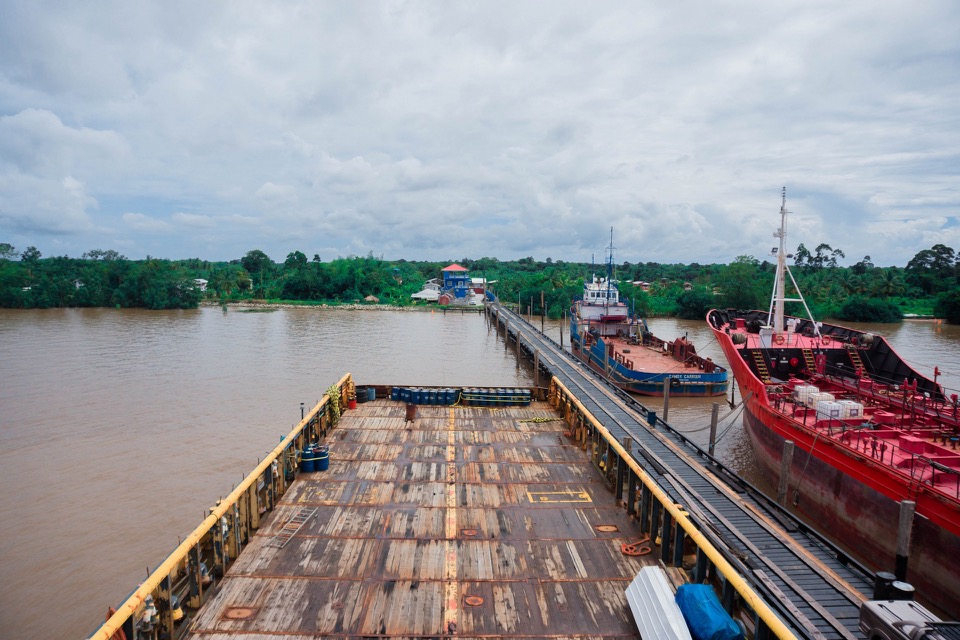
GCITI loads from its own wharf on the Essequibo, where deck barges and supply vessels lie alongside the timber jetty. Drums are stowed and lashed on the barge deck; liquid cargo is transferred by hose to a deck pump with a fire extinguisher stationed at the connection. It is the same berth the fleet has worked since the company started trading.
Where we work
- Guyana
- Suriname
- The Caribbean
- Latin America
Loading from our own wharf at Parika, East Bank Essequibo. Other services: petroleum import and wholesale, vessel chartering.
Questions buyers ask
What cargo can GCITI carry?
Liquid bulk — diesel, gasoline, heavy fuel oil and waste oil — plus dry bulk, containers, and deck or project cargo. Tell us the product and the volume and marine operations will confirm which hull suits it.
Where does GCITI operate?
From the wharf at Parika on the Essequibo, across Guyana's rivers and coast, and into Suriname, the Caribbean and Latin America.
How much liquid cargo can one vessel carry?
Published capacities run from 211,000 gallons on Candy Cruiser to 715,000 gallons on Candy Conqueror, the fleet's double-hulled tanker.
Can you reach shallow berths?
The fleet's shallowest published light draft is 7.5 feet, on Candy Coaster. Send us the berth and we will tell you which hulls can work it.
Do you carry deck and project cargo?
Yes. Candy Carrier publishes 550 long tons of deck space, and cargo is also carried in containers. Send dimensions and weights and we will confirm.
What do you need from me to quote?
Cargo type, quantity, load port, discharge port and your laycan. Anything unusual about handling is worth saying up front.
Do you own the vessels?
Yes. GCITI owns and operates its fleet rather than broking space on someone else's.
Submit cargo details
The brief opens with marine transportation already selected. Cargo, volume, ports and dates is enough to get a real answer back.